Eczema Treatment
in Bengaluru
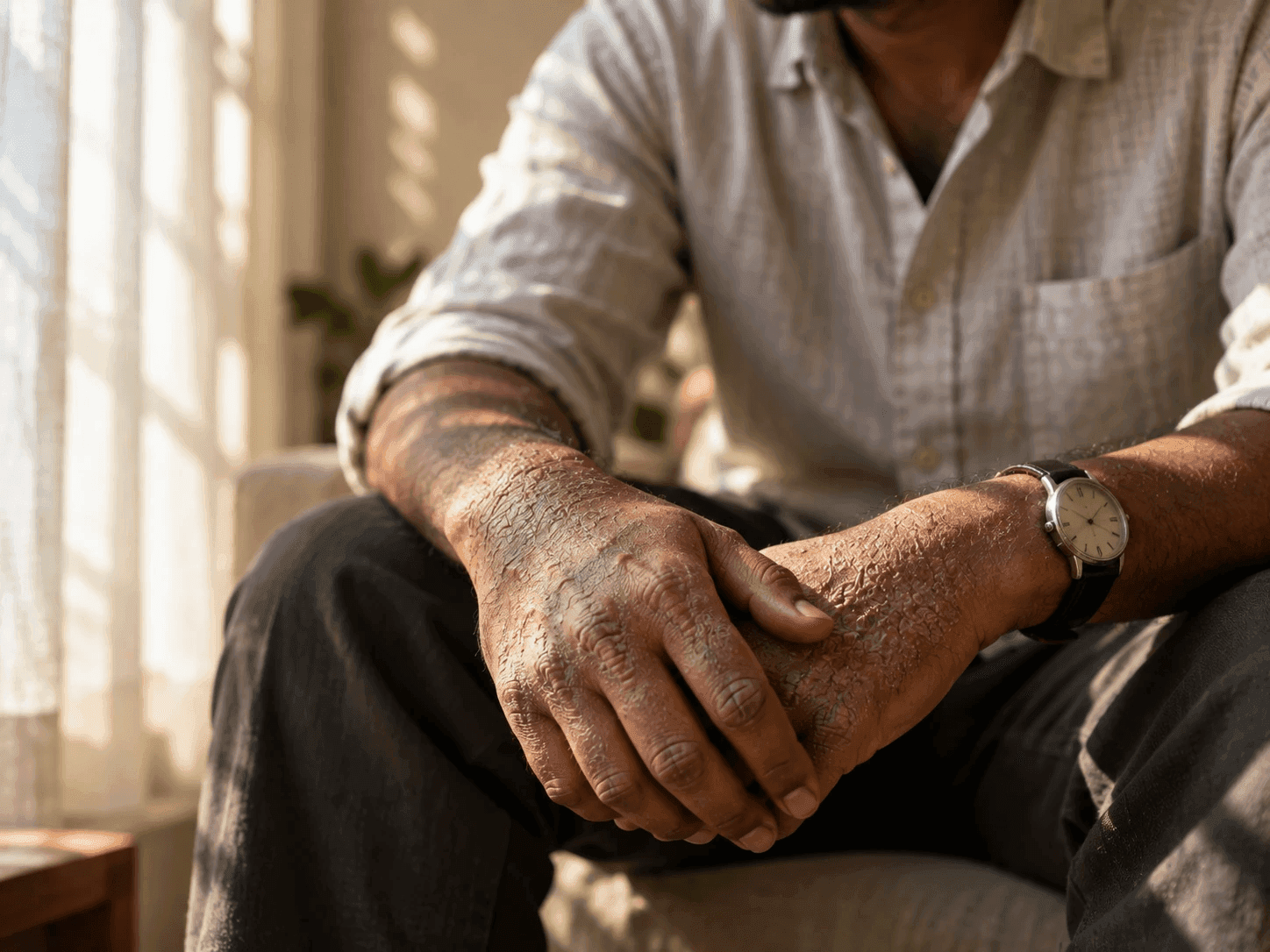
What is eczema, and why does it happen?
Eczema is a group of conditions characterised by itchy, inflamed skin. During an acute flare the skin becomes swollen and may develop small blisters or ooze. The oozing is often subtle and can look like a glazed layer over raw skin. Chronic eczema leaves the skin dry, rough, thickened and sometimes cracked.
Eczemas take many forms and can affect different parts of the body, but they share clinical and microscopic features. Skinmatics treats all types of eczema.
In Indian and darker skin types, eczema often appears brown, purple or grey rather than bright red. Light or dark marks can persist after the eczema itself has settled, which is why assessment by a dermatologist familiar with these skin types matters.
Why the skin barrier matters
The outer layer of skin contains lipids and proteins that form a barrier. It holds moisture in and keeps environmental irritants out. In eczema that barrier does not work as well as it should, influenced by genetic makeup, habits and environment. The skin loses its moisturising factors more readily, and allergens and irritants penetrate more deeply, triggering an immune response that leaves the skin inflamed, sensitive and itchy.
Scratching damages the barrier further and perpetuates the problem, creating an itch-scratch-itch cycle that is difficult to break without treatment.
Atopic eczema
Atopic eczema is one of the most common forms. It develops from an interplay of genetics, immune activity, lifestyle, habits and environment. Atopic individuals often have a family history of eczema, asthma, or a runny nose and sneezing, known as allergic rhinitis.
Contact dermatitis
Dermatitis can also occur when irritants or allergens overwhelm the skin barrier and trigger inflammation. Common household triggers include detergents and soaps that strip the skin of its lipids. Itchy, darkened, thickened or cracked skin under the nails or beneath a ring is often caused by substances building up between closely opposed surfaces. Nickel in ornaments can trigger an allergy in its own right.
Contact dermatitis is frequently occupational. It is commonly seen in:
- Labourers who work with cement
- Farmers handling pesticides or weeding with bare hands
- Homemakers using detergents and chopping fruit and vegetables that contain irritants
- Healthcare workers who sanitise and wash their hands frequently and wear gloves for long periods
We treat all types of eczema
- Atopic eczema in children and adults
- Irritant and allergic contact dermatitis
- Occupational dermatitis, including hand eczema
- Chronic, thickened and repeatedly flaring eczema
- Eczema that has not settled with over-the-counter creams
Skin tones we treat
- All Fitzpatrick skin types I through VI
- Specialist experience with South Asian skin types IV to VI
- Assessment accounts for eczema presenting brown, purple or grey rather than red
What makes eczema worse?
Eczema tends to improve and then return. Identifying what provokes a flare is part of managing the condition, and often explains why it keeps coming back.
| Trigger | How it contributes |
|---|---|
| Hot water and long baths | Strips the skin of the lipids that hold moisture in, leaving the barrier weaker after every wash |
| Harsh soaps and excess lather | Detergents and soaps remove the skin's own protective lipids. Scrubbing cannot remove eczema and makes it worse |
| Repeated washing and gloves | Frequent sanitising and long periods in gloves keep the barrier under constant stress |
| Rough fabrics | Wool and coarse textiles irritate skin that is already sensitised |
| Fragranced products | Perfume in cleansers, creams and detergents is a common contact allergen. Essential oils and herbal mixtures are not automatically gentle |
| Dry weather | Low atmospheric moisture dries the skin and provokes flares. Bengaluru's cool, dry spells commonly worsen eczema, while humid weather tends to settle it |
| Nickel and metals | Nickel in ornaments and jewellery can cause an allergic contact dermatitis in its own right |
| Scratching | Damages the barrier further and sustains the itch-scratch-itch cycle |
What happens at Skinmatics
Eczema is diagnosed clinically in most patients. The consultation establishes what kind of eczema it is, what is provoking it, and which treatment fits the person being treated.
Clinical assessment
The dermatologist examines the rash and takes a history of its onset and progression, how severe the itching is, how it affects sleep and daily activity, which products and cosmetics are in use, and what has already been tried. Skincare products are reviewed because they can themselves cause contact dermatitis.
ConsultationFull skin examination
Skin, hair, nails and mucosae are examined, along with a history of asthma, allergies, pregnancy or breastfeeding and any triggers the patient has noticed. Occasionally a scraping for fungus or a swab for bacteria is taken where there is doubt about the diagnosis.
Clinical ProcedurePatch testing
For recurrent eczema, patch testing identifies the specific allergen responsible. Identifying and avoiding a contact allergen is what allows some dermatitis to resolve rather than keep returning.
Diagnostic TestTopical treatment
Topical corticosteroids remain the most effective and cost-effective treatment for active eczema. The strength, formulation, duration and quantity are prescribed to the individual. Non-steroidal options including tacrolimus and pimecrolimus are safer for long-term use and can be used proactively on areas that flare repeatedly.
PrescriptionWet wraps
Applied for patients whose eczema is inflamed and intensely itchy, wet wrap therapy improves the effect of topical treatment and provides relief during a flare.
Clinical ProcedurePhototherapy
Controlled UV light therapy is offered to patients whose eczema is extensive or who have not responded adequately to topical treatment alone.
Light TherapySystemic treatment
For very extensive disease, oral medication or biologics are started after testing. Options may include conventional medicines such as cyclosporine, targeted biologic injections, or oral JAK inhibitors. The choice depends on age, medical history, pregnancy plans, monitoring requirements and availability. Repeated courses of oral steroids are generally avoided for long-term control.
PrescriptionLiving with eczema,
day to day
Bathing and cleansing
- Keep baths short, around 5 to 10 minutes, in lukewarm or cool water
- Avoid hot water, loofahs and vigorous scrubbing, all of which disrupt the barrier
- Use mild cleansers or syndet bars. Excess lather strips the skin of its lipids
- Adjust bathing frequency to age, environment, occupation and skin type rather than washing to a fixed routine
Moisturising
- Pat dry with a soft cotton towel rather than rubbing
- Apply a thick, bland moisturiser to damp skin, one without fragrance or colour
- Be generous with the quantity. Under-application is a common reason moisturising appears not to work
- Natural does not always mean gentle. Essential oils and herbal mixtures can cause allergy and contact dermatitis
Clothing and environment
- Choose loose cotton clothing
- Rough woollen fabrics irritate sensitised skin. Wear a cotton base layer underneath in winter
- Expect flares during dry weather and plan moisturising accordingly
- Eczema is not contagious. Nobody needs to be isolated and meals do not need to be served separately
Why moisturiser alone is not enough.
Moisturisers repair the skin barrier, but active eczema needs medicine to control the disease. Topical corticosteroids are among the oldest, most effective and most affordable treatments available for it. Concern about steroid creams is understandable, and usually comes from people who have encountered strong preparations without medical supervision. A steroid used as a fairness cream, or given for acne or a fungal infection by someone unqualified, causes harm. A specific steroid prescribed for eczema, at the right strength and for the right duration under a dermatologist's supervision, is a different matter entirely.
- MBBS and MD Dermatology qualified doctor at every clinic
- Strength, formulation, duration and quantity prescribed to the individual
- Non-steroidal and maintenance options for eczema that keeps returning
- Patch testing to identify the cause of recurrent contact dermatitis
- Honest assessment: recurrent eczema is managed, not cured
Available at all five clinics
Eczema treatment is available at all Skinmatics locations in Bengaluru and Chennai. Book at your nearest clinic or call us to confirm availability at a specific branch.