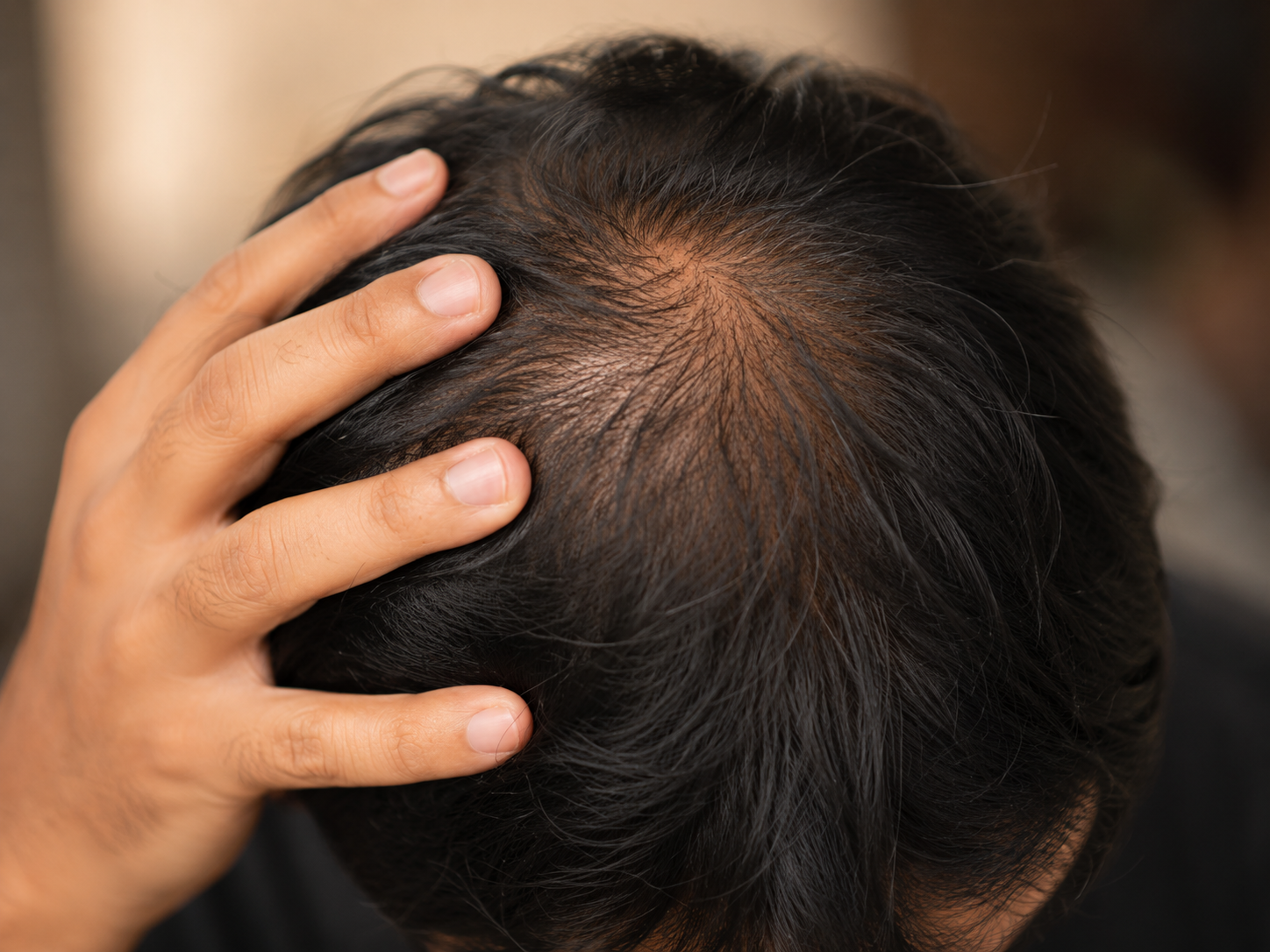
What is PRP therapy for hair loss?

PRP therapy involves drawing a small amount of the patient's own blood, processing it in a centrifuge to isolate and concentrate the platelet-rich plasma, and injecting it into targeted areas of the scalp. Platelets contain growth factors that promote tissue repair and cellular regeneration. When injected into the scalp, these growth factors stimulate dormant or weakened hair follicles, improving hair density, thickness, and growth rate.

Because PRP is derived from the patient's own blood, the risk of allergic reaction or rejection is minimal. It is a safe, non-surgical option for patients in the early to moderate stages of hair loss, where follicles are still present but underperforming.

Who is this suitable for?

  • Men and women with hair thinning or early to moderate hair loss
  • Androgenetic alopecia in the earlier stages
  • Diffuse thinning and post-pregnancy hair loss
  • Not recommended alone for very advanced baldness with no active follicles

Skin tones we treat

  • All Fitzpatrick skin types I through VI
  • Specialist experience with South Asian skin types IV to VI
  • Protocols adjusted per skin type to minimise PIH risk

What causes hair thinning?

Hair thinning and loss can result from a range of factors. PRP is most effective when the underlying cause is identified alongside treatment.

Cause How It Contributes
Androgenetic alopecia Pattern hair loss driven by DHT, the most common cause in both men and women
Hormonal imbalances PCOS, thyroid dysfunction, and post-pregnancy hormonal shifts are significant causes in women
Nutritional deficiencies Iron, vitamin D, and B12 deficiencies are frequently seen in Indian patients with hair thinning
Stress Physical or emotional stress can push large numbers of follicles into a shedding phase simultaneously
Medications Certain drugs including blood pressure medications and antidepressants can cause hair shedding
Scalp conditions Dandruff, seborrheic dermatitis, and inflammation can weaken follicles over time

How PRP works at Skinmatics

Unlike most of our treatments, PRP is a single procedure carried out in three sequential steps, not a menu of options. Each session follows the same three steps in order.

01
Blood Draw
A small amount of blood is drawn from your arm, in the same way as a routine blood test. The quantity required is small, typically 10 to 20ml, and the process takes only a few minutes.
Step 1
02
Centrifugation
The drawn blood is placed in a centrifuge machine and spun at high speed. This separates the blood into its components and concentrates the platelet-rich plasma, isolating the growth factors needed for treatment.
Step 2
03
Scalp Injection
The concentrated PRP is injected into targeted areas of the scalp using a fine needle, placed at regular intervals to ensure even distribution. The full injection process typically takes 30 to 60 minutes, with a numbing cream or local anaesthesia available beforehand.
Step 3

Before, during,
and after your treatment

What happens before your treatment
  • Consultation to discuss your hair loss concerns and medical history
  • Avoid blood-thinning medications such as aspirin before each session
  • Refrain from alcohol for a few days before each session
  • No special scalp preparation required beyond normal hygiene
What happens during your treatment
  • Blood draw, followed by centrifugation to prepare the PRP
  • PRP injected into the scalp at targeted sites
  • Mild pressure and brief stinging at injection sites is normal
  • The full session takes approximately 30 to 60 minutes
What happens after your treatment
  • Avoid washing your hair for at least 24 hours after each session
  • Mild soreness at injection sites is normal, resolving within a day or two
  • Ice gently applied to the scalp can help with discomfort
  • Avoid strenuous exercise, sun exposure on the scalp, and alcohol for 24 to 48 hours

What to expect,
and how many sessions

TimelineWhat to Expect
24 hours post-sessionAvoid washing hair, mild soreness at injection sites is normal
Week 1 to 2Scalp sensitivity resolves, no visible change yet
Month 1 to 3Reduction in shedding typically noticed first
Month 3 to 6Improved hair thickness and new growth in treated areas
Month 6+Continued improvement with maintenance sessions

Most patients benefit from an initial course of 4 to 6 sessions, spaced approximately 4 to 6 weeks apart. After completing the initial course, maintenance sessions every 6 to 12 months help sustain the results. The exact number of sessions and spacing depends on your hair loss severity and how your scalp responds to treatment, assessed at follow-up appointments.

Dermatologists who know Indian skin.

Skinmatics has treated over 10,000 patients across 5 clinics in Bengaluru and Chennai. PRP therapy is performed by MBBS, MD-qualified dermatologists who conduct a holistic assessment before recommending treatment. The clinic's experience treating Indian patients means contributing factors such as nutritional deficiencies, PCOS-related hair loss, and stress-triggered shedding are identified and addressed alongside PRP therapy rather than treated in isolation.


  • MBBS, MD-qualified dermatologist at every clinic
  • Holistic assessment before every PRP recommendation
  • Specialist experience with Fitzpatrick types IV to VI
  • Personalised plans reviewed and signed off by your doctor
  • Honest assessments at every consultation, no guaranteed outcome claims
5
Clinics across Bengaluru and Chennai
10K+
Patients treated since founding
7
MBBS, MD-qualified dermatologists
USFDA
Cleared technologies in every clinic

Available at all five clinics

PRP hair treatment is available at all Skinmatics locations in Bengaluru and Chennai. Book at your nearest clinic or call us to confirm availability at a specific branch.

Questions about PRP hair treatment

What is PRP therapy and how does it work?
PRP (Platelet-Rich Plasma) therapy involves drawing a small amount of your own blood, processing it in a centrifuge to concentrate the platelets, and injecting the resulting plasma into the scalp. Platelets contain growth factors that promote tissue repair and cell regeneration. When injected into the scalp, these growth factors stimulate dormant or weakened hair follicles, improving hair density, thickness, and growth rate over a course of sessions.
Is PRP therapy safe?
Yes. PRP therapy uses the patient's own blood, which significantly minimises the risk of allergic reaction, rejection, or infection. Because no foreign substances are introduced, it is considered one of the safest available treatments for hair loss. As with any injectable procedure, there is a small risk of bruising, swelling, or infection at injection sites, but these are rare when the procedure is performed by a qualified dermatologist under clinical conditions.
How many PRP sessions will I need?
Most patients benefit from an initial course of 4 to 6 sessions spaced 4 to 6 weeks apart. After completing the initial course, maintenance sessions every 6 to 12 months help sustain and build on the results. The exact number of sessions and spacing is determined based on your hair loss severity and your scalp's response to treatment, which is assessed at each follow-up appointment.
How soon will I see results from PRP therapy?
PRP works gradually. The first sign of response is typically a reduction in shedding, usually noticed 4 to 8 weeks into the treatment course. Visible improvement in hair thickness and new growth in treated areas typically becomes apparent from 3 to 6 months into the course. Full results from the initial treatment course are generally assessed at 6 months. Results continue to improve with maintenance sessions.
Is PRP therapy painful?
Most patients experience mild pressure and brief stinging at injection sites during the procedure. A numbing cream or local anaesthesia can be applied to the scalp before injections to reduce discomfort. After the session, mild soreness at injection sites is common and typically resolves within 24 to 48 hours. Applying ice to the scalp can help if soreness is felt after the session.
What is the difference between PRP and a hair transplant?
PRP is a non-surgical treatment that stimulates existing hair follicles using growth factors derived from your own blood. It is most effective when follicles are still present but weakened or dormant, making it suited to early to moderate hair thinning. A hair transplant is a surgical procedure that physically moves follicles from a donor area to areas of permanent baldness. Patients with advanced hair loss where follicles are completely gone will not see results from PRP alone and may require transplant. Many patients benefit from combining both, using PRP to support transplanted follicles and maintain surrounding hair.
Can women use PRP for hair loss?
Yes. PRP is suitable for women experiencing hair thinning due to androgenetic alopecia, PCOS-related hair loss, post-pregnancy shedding, or diffuse hair thinning. Women often respond particularly well to PRP because female hair loss more commonly involves follicles that are weakened rather than permanently lost. A clinical consultation will assess your hair loss pattern and determine whether PRP, another treatment, or a combination approach is most appropriate.
Can PRP be combined with a hair transplant?
Yes. PRP is commonly combined with hair transplant to support healing and stimulate the transplanted follicles. The growth factors in PRP may promote faster recovery and denser growth from the transplanted grafts. PRP can also be used as a maintenance treatment after transplant to slow hair loss in non-transplanted areas. Your dermatologist can advise whether combining the two treatments is appropriate for your case.
Are there any side effects of PRP therapy?
Because PRP uses your own blood, serious side effects are rare. Common and expected responses include mild redness, swelling, or soreness at injection sites, all of which typically resolve within 24 to 48 hours. Temporary scalp sensitivity for a day or two after treatment is normal. Serious complications such as infection are very rare when the procedure is performed under clinical conditions by a qualified dermatologist.
How is PRP different from other hair loss treatments like minoxidil?
Minoxidil is a topical medication applied daily to the scalp that stimulates blood flow to follicles and prolongs the hair growth phase. It requires continuous daily use to maintain its effects and results stop if it is discontinued. PRP works by delivering concentrated growth factors directly into the scalp, stimulating follicle activity from within. PRP sessions are spaced weeks apart and results are maintained with periodic maintenance sessions. Both can be used together, and your dermatologist can advise on whether a combined approach is appropriate.
Will PRP work for complete baldness?
PRP is most effective when hair follicles are still present, even if weakened or miniaturised. In areas of complete baldness where follicles have been permanently lost, PRP is unlikely to produce significant results as there are no follicles to stimulate. Patients with advanced hair loss in specific areas may be better suited to hair transplant, which physically restores follicles in those areas. A clinical assessment is the only way to determine which approach is appropriate for your hair loss pattern.
What is the cost of PRP hair treatment in Bengaluru?
The cost of PRP therapy depends on the number of sessions in your treatment plan and the area being treated. An accurate cost estimate is provided at your initial consultation once your hair loss pattern has been assessed and a treatment plan designed. Booking a consultation is the first step to understanding what your treatment will involve and what it will cost.
Ready to take the first step?
Book a Consultation Chat on WhatsApp
© 2026 Skinmatics. All rights reserved. Skinmatics Dermatology · Crafted by Arun ↗